Phrasal verbs are everywhere in spoken English. Have these word combinations ever left you wondering exactly what people mean? A manager might ask you to follow up with a client (not follow along with them). A coworker may ask you to work through a problem (not work on it). A business owner might decide to take on a larger project (not take off).
These expressions can be challenging because adding a short word such as on, up, or through can completely change the meaning of a familiar verb. Learning them in groups can make them easier to understand and remember.
Try them out as soon as you can because phrasal verbs make your English sound more fluent, precise, and professional. In other words, phrasal verbs can help you make your point across and connect with others.
In this lesson, we will follow two Inglés Increíble characters. Maria is a project coordinator building confidence in the workplace. Beto is a skilled building contractor learning the language of running his own business. Their situations will help you learn 15 practical phrasal verbs that you can use at work and in everyday conversations. Read till the end and challenge yourself with a little practical exercise.

Phrasal verbs with LOOK
1. Look for
Meaning: To try to find someone or something.
Maria might say:
I’m looking for the project file.
Beto might say:
I’m looking for the right tool.
Use look for when the thing you need is missing or you do not yet know where it is.
2. Look after
Meaning: To take care of someone or something.
Maria looks after the new employee.
Beto looks after his crew.
Looking after someone can mean helping, protecting, supervising, or making sure that person has what they need.
3. Look forward to
Meaning: To feel excited or pleased about something that will happen.
I’m looking forward to the weekend.
We look forward to starting the project.
After look forward to, use a noun or an -ing verb:
- I’m looking forward to the meeting.
- I’m looking forward to meeting the team.
Do not say, “I’m looking forward to meet the team.”
Phrasal verbs with TURN
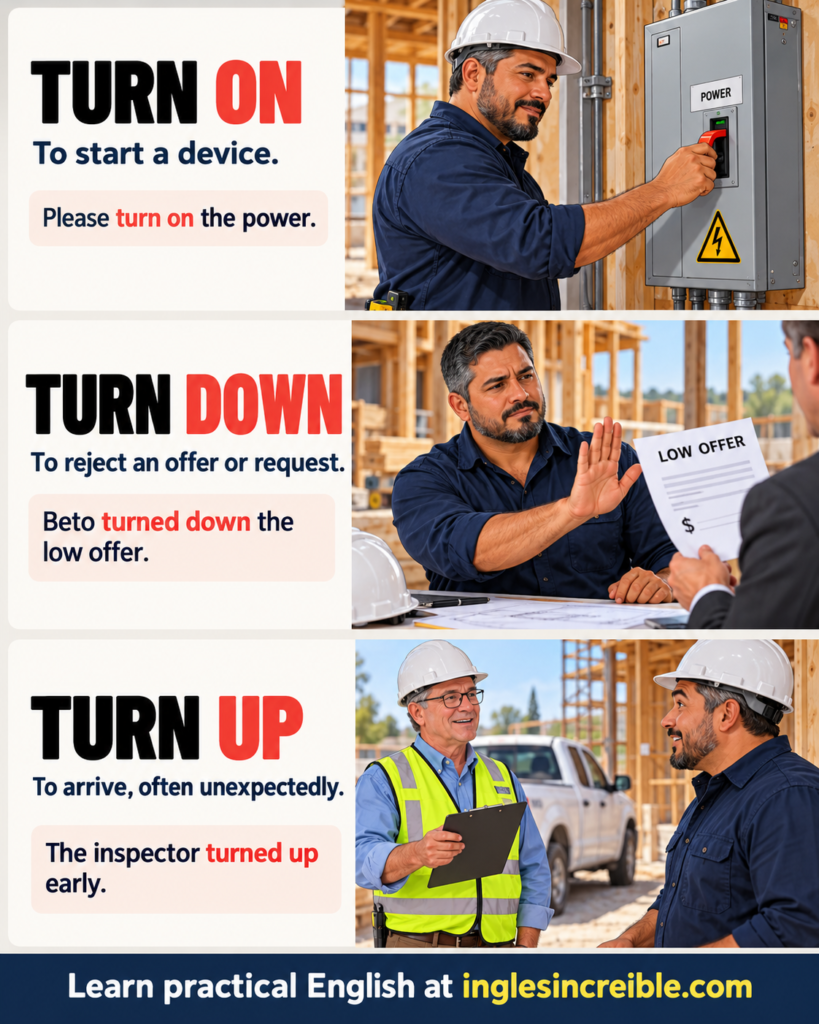
4. Turn on
Meaning: To start a device, machine, light, or source of power.
Please turn on the computer.
Please turn on the power.
With a noun, you can say turn on the computer or turn the computer on. With a pronoun, place it in the middle: turn it on.
5. Turn down
Meaning: To reject an offer, invitation, or request.
Maria turned down the job offer.
Beto turned down the low offer.
Turn down can also mean to reduce volume or heat, but context makes the intended meaning clear:
Could you turn down the music?
6. Turn up
Meaning: To arrive or appear, sometimes unexpectedly.
Kevin turned up late to the meeting.
The inspector turned up early.
In informal English, turn up often has a similar meaning to show up. It can also mean to increase volume or heat:
Please turn up the heat.
Phrasal verbs with WORK
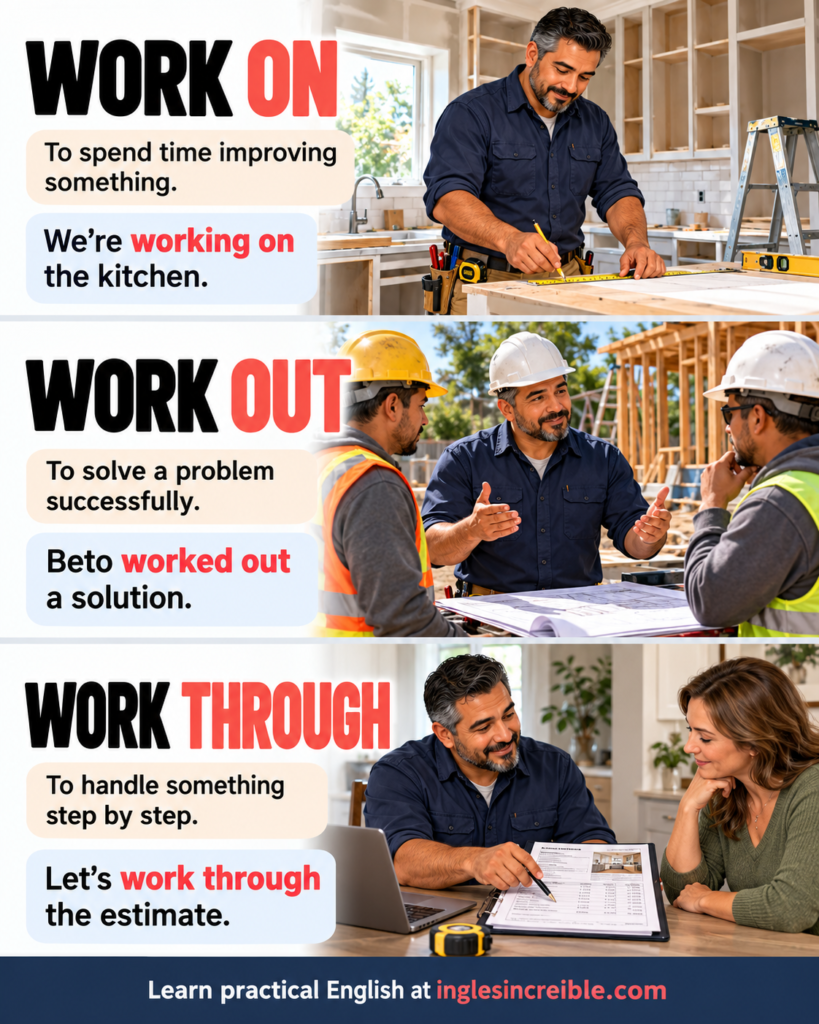
7. Work on
Meaning: To spend time doing or improving something.
We’re working on the presentation.
We’re working on the kitchen.
You can work on a report, a skill, a relationship, a repair, or almost anything that requires effort and attention.
8. Work out
Meaning: To find a solution or reach a successful result.
I’m sure we can work it out.
Beto worked out a solution.
Work out also has other common meanings. It can mean exercising—“I work out three times a week”—or developing successfully—“Everything worked out in the end.”
9. Work through
Meaning: To address something carefully, usually one step at a time.
Let’s work through the details.
Let’s work through the estimate.
Use work through when a problem, document, or difficult situation requires time and careful attention.
Phrasal verbs with TAKE
10. Take on
Meaning: To accept work, responsibility, or a challenge.
Maria took on a new project.
Beto took on a larger project.
Taking on something usually suggests that it will require effort. You might take on a new client, a leadership role, additional work, or a difficult challenge.
11. Take over
Meaning: To assume control or responsibility from another person.
Maria will take over while Rachel is away.
Marcus will take over this afternoon.
You can take over a project, take over a meeting, or simply take over for someone who needs to leave.
12. Take off
Meaning: To become popular or successful very quickly.
Maria’s career is taking off.
Beto’s business is taking off.
This expression creates the image of an airplane leaving the ground. Take off can also literally mean leaving the ground or removing clothing:
The plane took off on time.
Please take off your jacket.
Phrasal verbs with FOLLOW
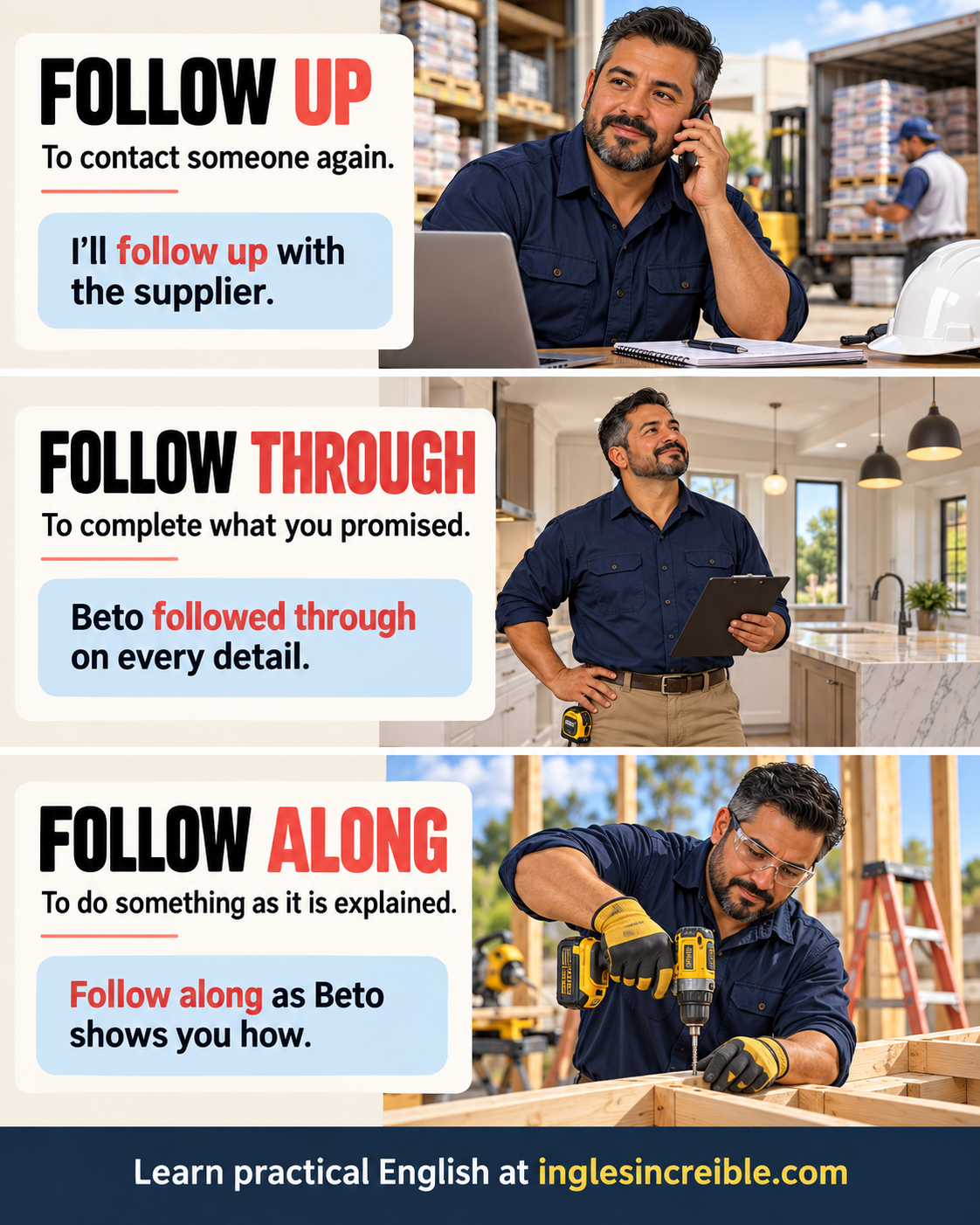
13. Follow up
Meaning: To contact someone again or take another action after an earlier conversation.
I’ll follow up with the client tomorrow.
I’ll follow up with the supplier.
You can follow up with a person or follow up on a topic:
I’m following up with Elena about the invoice.
I’m following up on our conversation from Monday.
14. Follow through
Meaning: To complete something that you promised or started.
Maria followed through on the plan.
Beto followed through on every detail.
Someone who follows through is reliable. They do not simply make promises; they complete the necessary actions.
15. Follow along
Meaning: To do or understand something while another person explains or demonstrates it.
Please follow along as I demonstrate.
Follow along as Beto shows you how.
In a lesson or presentation, a speaker may ask you to follow along in a book, document, or set of instructions.
A short practice challenge
Choose the best phrasal verb to complete each sentence. Change the verb tense when necessary.
- I’ll __________ with the customer tomorrow morning.
- We need to __________ the problem before the inspection.
- She decided to __________ a new leadership role.
- Could you __________ the lights?
- I’m __________ meeting the new team.
- The supplier __________ two hours late.
- Let’s __________ the contract one section at a time.
- He made a promise, but he didn’t __________.
Answers
- follow up
- work out
- take on
- turn on
- looking forward to
- turned up
- work through
- follow through
Keep building your practical English
You do not need to memorize every possible meaning of a phrasal verb at once. Start with expressions connected to situations you experience regularly. Then practice each one in a sentence about your own work or life.
Maria and Beto are building their careers in different environments, but both need clear, confident English to solve problems, lead others, and create new opportunities. You can build that confidence too—one useful phrase at a time.
Whether you are building a career, a business of your own, or even going to school, you can sound more fluent and professional with free, practical English lessons, at Inglés Increíble. And, if you want to learn even more phrases that will supercharge your English, download your Professional English Toolkit, designed especially for Spanish-speaking professionals who already understand English but want to sound clearer, more natural, and more confident.